Strong Bones, Strong Life | Orthopaedic Care Podcast with Dr. A. Devadoss | Dr. Hema Sathish
Strong Bones, Strong Life | Orthopaedic Care Podcast with Dr. A. Devadoss | Dr. Hema Sathish
Table of Content:
- Physical activities to keep yourself young
- Arthritis in younger people
- Is it fine to continue squatting in Indian toilet?
- Signs to stop squat
- Importance of Vitamin D
- How to avoid further damage in Arthritis
- When should you wear a brace and when not to wear a brace. And when should you stop wearing the brace for osteoarthritis?
- Is it beneficial to use knee brace while playing games?
- Taking pills or using heating pads. Which is better?
- When to use cold and hot water treatment?
- When to reduce medication?
- Bone loss happens only in women, Men don’t have bone loss at all, is it?
- Women going through menopause develop arthritis, myth or fact?
- Osteoporosis during menopause
- What are the problems which we are facing using the phones?
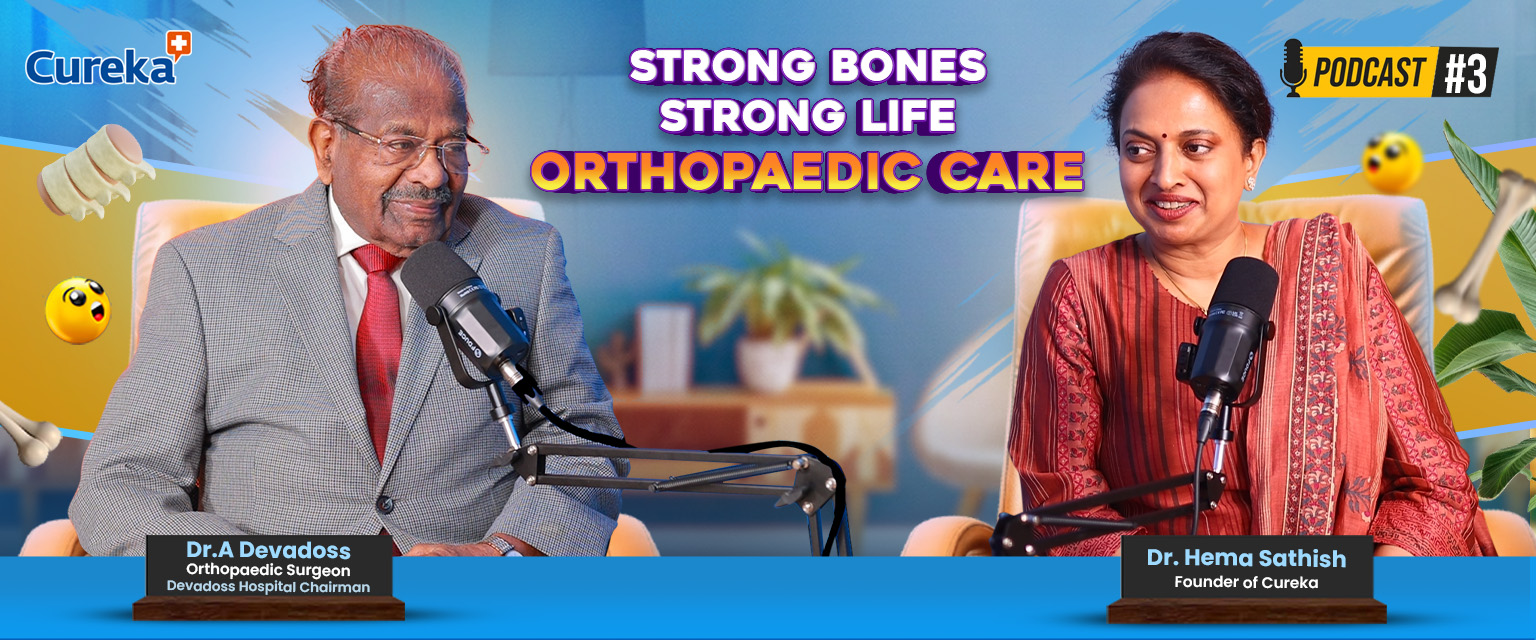
Dr. Hema Sathish: Hello everybody, I’m Dr. Hema Sathish, and today we have Dr. A. Devadoss, who’s a legend in orthopaedics. He’s a legend in every way. He’s been an inspiration to many, and a real inspiration to me. He’s not only a legendary orthopedic surgeon. I’m very happy to introduce him as my father-in-law today. Welcome today. Dr. A. Devadoss: Thank you.
Dr. Hema Sathish: So we all hear that stronger the bones, stronger the life. So stronger the bones, stronger the orthopedic surgeon, is it?
Dr. A. Devadoss: I can’t say that because if the bone is strong, they may not come to us. Because as you get older, the osteoporosis will come in, definitely. So automatically they have to come to us. So stronger the orthopedic surgeon, maybe because of the weak bones only, they will come to me. That’s true.
Dr. Hema Sathish: But nevertheless, the orthopedic surgeon has to be really strong to handle bones. Dr. A. Devadoss: No doubt about it.
Dr. Hema Sathish: So mama, could you tell us about your age? You want to reveal your age today and tell how you keep yourself going at this age. Trust me, he operates even today. There’s not a single day which passes by where he doesn’t practice his orthopaedics, where he doesn’t take care of his patients, where he doesn’t operate. So please tell us more about that.
Dr. A. Devadoss: This is because I’m 89 now, running now. But still I do my yoga and also walking. And from younger onwards, I used to play quite a lot. Even when I was in the school as well as when I was in England as well. And I used to play a lot of tennis and even in the medical college, we used to play all the games. It was compulsory at that time. So we have a very strong biceps muscle and all that. So I still, even now, I’m a little stronger than my PGs, you know.
Dr. Hema Sathish: I’ve heard about that several times.
Dr. A. Devadoss: Whenever I want them to pull and all that, I do better than them. So that is because of that. Because I keep myself busy with my exercises and also with my reading as well. So that’s another important thing to keep myself updated. And that’s why I still feel young with my postgraduates and move about and all that.
Dr. Hema Sathish: So you seem to be following all the rules of keeping yourself young: Reading Keeping yourself active Keeping yourself surrounded with younger people
Dr. A. Devadoss: Yeah, that’s true.
Dr. Hema Sathish: So is there some more secret to that?
Dr. A. Devadoss: No, not really. All my boys are there in PGs, no problem at all.
Dr. Hema Sathish: Okay. So when you were talking about keeping yourself agile, active, and you have been doing a lot of exercises when you were younger. So it was not like exercise, exercise, where you trouble yourself. But you’ve been enjoying games and in that way you’ve been quite physically fit. So is it true that the bones are a tell-tales of what you have done in your earlier life?
Physical activities to keep yourself young
Dr. A. Devadoss: As regards the bone is concerned, the more they active, because when you are active, the muscles which are attached to the bone, they get more vascularity. So the bone gets stronger as well. The more you have a sedentary life, you’ll find the bones becomes osteoporotic. That means the bones become soft and also it’s not strong as well, even in the younger age group. Many of them may have a sedentary work and we have seen many patients with osteoporosis, even in the younger age group also. The more you are active, even at the age of plus 60 also, it’s very important that you must keep yourself active, keep your muscles active, then you find your bone will not give any pain.
Dr. Hema Sathish: That’s wonderful to know. So when you say activities, there’s one thing I was thinking when you were saying younger, I mean for you younger is not like small children, right? So what is the age group you were referring to when you said younger?
Dr. A. Devadoss: I would say at the age of 60, 60 is okay.
Dr. Hema Sathish: All right, so 60 is also young guys, remember that.
Dr. A. Devadoss: Yes. After that probably you have to do active also, there’s no doubt about it. But to the certain limits regarding cardiac reserve, your respiratory reserve and all that, when you keep going as much as possible, that’s very important in life.
Dr. Hema Sathish: Nowadays what we see is everybody gets into this exercise mode, then this protein mode and then dietary changes, which are so drastic from what we actually traditionally people tend to eat. So what is your take on that? Because I’ve seen people, you know, suddenly after 50 they want to work out because they want to be slim and trim and all and then they do crash diets to become slim. So if they do that, is it harmful or it’s fine to start that late and start aggressively? Dr. A. Devadoss: That again, it depends on the individual itself. Suppose the patient is very obese and all that. Suppose they want to reduce their weight by going for the gym and all that at the age of 50, 55, 60 and all that, they may get into trouble. They may get into trouble. So we have to be very careful regarding your age as well as your obesity, your weight and all that and also your food habits. Suppose suddenly you change your food habit again, you may have problems.
Dr. Hema Sathish: So your medical conditions also matter when you start off late. So you consider all that and depending on that, they should plan what they should do right for themselves. And starting early is the best thing, of course, from what you have said so far, I gather that. Now if arthritis has stepped in, which is very, very common. We have seen younger people also have arthritis, like in their 30s, 40s and unfortunately some younger children also get it because of genetic problems and autoimmune diseases and all. So would you like to explain something more on that?
Arthritis in younger people
Dr. A. Devadoss: Yeah, as far as in children is concerned, arthritis of the polyarthritis in general, many joints may be involved, probably after rheumatic fever sometimes. And where you will find the patient had a streptococcal sore throat and the child may get polyarthritis. And that is in children. Apart from that, they have what’s called juvenile rheumatoid arthritis, where the children, they have polyarthritis, various joints are involved, just like in adults, they may go into a very crippling problem as well. So that is in children. In the younger age group, for example, 20, 30, 35 and all that, that is because it’s very common to have what’s called a condition called contramallatia petala, where a patient, for example, an IT fellow or a lady, he sits in the computer, PC, for example, for 3 or 4 hours continuously, the petala stick is sort of bent like this in 90 degrees and is hitting against the table as well. So they will have chronic pain in the knee joint as well. When they get up, they have pain. When they go upstairs, it is common to have pain. Coming down the stairs also, they have pain. Now that is because the petala is the one that gives stability to the knee joint. Now when they go upstairs, 7 times the body weight is going through the petala to the femoral part. So that is very important to know about. So they have chronic pain coming to us with a pain in the knee joint or sometimes the swelling as well. Now when they sit for 3 hours, olden days it is called as a cinema sign. Olden days all the movies would go for 3 to 4 hours, like 5 hours and all that. Nowadays all the movies are 2 hours or less than that. But still it’s called a cinema sign and now I call it as an IT sign. Because they sit in the chair for a long time, they get a contramallatia petala.
Dr. Hema Sathish: So it’s interesting to know that not only conditions have, I mean we have also evolved as human beings, but not only that, names of conditions have also evolved over time I guess. That’s quite interesting to know. So what about the later part like 40s now?
Dr. A. Devadoss: Later part 40s, usually they come to us with a significant squatting in the Indian toilet. When they get up, they can’t get up. Then once they get up, they become abnormal. That’s the sign of early osteoarthritis of the knee joint.
Dr. Hema Sathish: So do you advise using some toilet seats in their cases or it’s fine to continue? Because sometimes they say if we stop doing what you are doing, then it can get worse. Is it true or if they continue doing that?
Is it fine to continue squatting in Indian toilet?
Dr. A. Devadoss: They can continue that provided they are able to get up with the support on that side. Because as I found out that the more you flex the knee joint, the synovial breathing of the article cart is much, much better. So in that way squatting is also good for some time. But sometime after the age of 50, 60 and all that, the cartilage gets worn out automatically, they have difficulty in squatting in the Indian toilet. So they have to go for a western toilet.
Dr. Hema Sathish: So what would be the sign where they should say that you would want to tell them that don’t squat any further? Because that’s normal. So when would you say don’t squat any further?
Signs to stop squat
Dr. A. Devadoss: Suppose the patient comes to me with pain and swelling also. Whenever there is swelling, they must stop doing that because the cartilage gets worn out and the particles of the cartilage get absorbed by the synovial fluid and that produces synovial fluid. So they get a swelling, warmth and pain and all that. So at that time probably they would stop squatting.
Dr. Hema Sathish: So that was quite a lot of information because many a times what people believe is if they continue doing it then it’s better. But there is a time where they have to stop, right? The heart stop has to come.
Dr. A. Devadoss: Whenever there is swelling and very painful on walking also. Even on walking they have pain, they must stop squatting.
Dr. Hema Sathish: So when we talk about arthritis, there is such a huge buzz about vitamin D and vitamin D is a very big market now. So what is your experience and what would your opinion be on that?
Importance of Vitamin D
Dr. A. Devadoss: Actually vitamin D3 is very important for calcium absorption. All of us know about it. But at the same time the bone matrix has to get calcium. So in arthritis it is only these are the articular cartilage. So in arthritis we don’t need vitamin D at all. But if the patient has got osteoporosis, they must take vitamin D plus calcium so that they can improve their bone quality. Especially the bone matrix is much getting better also. So in that way vitamin D is very useful and also many of our boys and young patients are working in the atmosphere of air condition. So they don’t expose themselves to sunlight at all. So that is another reason they must take vitamin D3 as well. At the same time they must go for walking at least once a week in the sunshine. So that they get some, there is plenty of vitamin D3 available in the sun. So they must get some sunshine as well. That’s also very important. Because we have certain community people who are not exposed to sunshine at all. They come to me with osteoporosis plus osteomalacia. Osteomalacia is a condition where there is vitamin D deficiency at all. So they have to take vitamin D plus sunshine also. That’s very important.
Dr. Hema Sathish: So the sunshine vitamin is vital as everybody says. And probably not directly related to arthritis. But yes it does make a difference. So now if arthritis has set in. So it can be possible, I mean can it be possible to avoid it from any further damage? So what would your advice be in that case?
How to avoid further damage in Arthritis
Dr. A. Devadoss: Usually it is very important as far as the knee joint is concerned. You are talking about knee joint. Or even the other joints also involved in it.
Dr. Hema Sathish: Nowadays elbow arthritis also very high because of phone usage right?
Dr. A. Devadoss: That is true. They have pain in the shoulders. As far as the knee is concerned for example. If the patient has come to me with the pain in the knee joint. Patient at home what they have to do is. They can’t come to the hospital. If the patient is obese we ask them to reduce their weights. Reduce their carbohydrate intake and ask them to take as much protein as possible. At the same time I usually ask them to take quadriceps exercises. Quadriceps exercises are very important. There are four muscles around the knee joint. Which helps in your, they are the key muscles. Especially the last muscle to develop in the body is the vastus medialis. Now that muscle is the one that key muscle for the knee joint. So that we teach them exercises to do at home. And at least 75% of the patient they get better only with exercises. Plus local application of some gel or some pain relievers. Ointments or something. So in that way they can treat that arthritis at home itself. Without taking much tablets. Very minimal tablets. That’s very important. Physiotherapy exercise is very important which they do by themselves. Not go to the physiotherapist not necessary at all. But they do it themselves religiously, consciously and regularly. That is very important.
Dr. Hema Sathish: That’s mandatory. So consistency is key. But nowadays when you get a knee pain everybody just happily wears a brace. So it’s not mandatory. Sometimes I feel why wear a brace when you do not have some issues. Like ligament problems yes it does help. But not for osteoarthritis. So in osteoarthritis when should you wear a brace and when not to wear a brace. And when should you stop wearing the brace.
When should you wear a brace and when not to wear a brace. And when should you stop wearing the brace for osteoarthritis?
Dr. A. Devadoss: That’s a very good question because many of my patients come to the kneecap. On both sides. Then I tell them when I examine them the quadriceps muscle is completely weak. Very much wasted. So it’s very important that to do exercise is very important. The kneecap best kneecap is your vastus medialis muscle. Once you build it up with the exercises against resistance at home with a theraband. You can use weights also like ankle weights and that is better rather than wearing the kneecap. Now sometimes you find the patient has got a mild deformity. Then we got what is called an osteoarthritis knee brace which is called offloading. That is on the inner side the load is taken off by the brace. So that is very very helpful for patients with the early osteoarthritis with a varus deformity. That means mild bowlegs. In that case braces are must and they are very comfortable with that. They are able to flex the knee as well. They can squat also with that. So it is very very useful offloading on the inner side. That is very important. Now when you will stop kneecap wearing once quadriceps muscle is good. They are happy. The patient is also happy with no instability of the knee joint. He is very comfortable. Then you can stop wearing the brace at all. That is very important.
Dr. Hema Sathish: And not only that but sometimes you know when you are playing games and all. So there are many people who use a knee brace just to avoid injuries. So is it beneficial or is it not? No that is beneficial.
Is it beneficial to use knee brace while playing games?
Dr. A. Devadoss: That is beneficial. Because even for tennis players or cricket players you will find very often they have to twist the knee and all that. Definitely some support is given. But once they come out of it from the ground and all that they have to go for physiotherapy.
Dr. Hema Sathish: They should do some exercise after that also. So make sure that the muscles around the joint are back to normal. So that is quite interesting. So the idea is you can use a brace but nevertheless do not stop the exercises. So if you stop the exercises and you are using the brace then you are going to weaken the muscles also around the joints which is not a good thing to do.
Dr. A. Devadoss: That is very important. What you said is correct because if you stop exercises your muscles get wasted. Once the muscles get wasted you will have more pain again in the knee joint. Instability, pain on walking. Exercises are very very important.
Dr. Hema Sathish: So for pain relief there are many many of course muscle relaxants also are there. At the same time you have opioids for pain relief and there are many many drugs in the market. So sometimes you have to use it for a very very long time. So what is your suggestion? Would you like to say that you can use other like sometimes heating pads or cool gel packs. Will they also help relieve pain or only in acute conditions you should take pills to swallow and then rest of the time you can try these also or you can reduce the medications by trying this. What would your take be on that?
Taking pills or using heating pads. Which is better?
Dr. A. Devadoss: Yeah sometimes you will find patient has got a chronic pain for example and during acute phase you have to give them drugs. Sometimes we give by parental route as well or they can take tablets as well. Many of the patients will have all the painkillers have stomach problem. So that is acid peptic disease will come. So in such patients probably you may have to give them some massage or something like that and also sometimes cryotherapy is very useful. Suppose there is a swelling is there. Cryotherapy in the form of ice pack therapy and also if there is no swelling probably they may use a hot pad as well. That’s also very helpful.
Dr. Hema Sathish: So if there is a swelling it’s ideal to use something cold to reduce the inflammation and the swelling and once that settles then you can do heat. Some people talk about alternating heat and cold. So would you advise something like that?
When to use cold and hot water treatment?
Dr. A. Devadoss: That is called contrast bathing. That is very useful for ankle foot pain and all that. And knee joint as far as possible you have to give them one of these only. Foot and ankle contrast bathing is better because when you keep the foot in cold water you get a vasoconstriction. So for one minute you keep moving the ankle and foot and all that. Then once you do that after one minute you put it in hot water. When you do that that increases vasodilation because of the heat treatment. So when that happens the pain substance washed away by the increased venous return. So that’s how it works. Alternate heat and cold is very useful for foot and ankle. It’s very useful also for the hand as well.
Dr. Hema Sathish: Alright okay that’s nice to know. And now when do you reduce the medications if they are supposed to if they can take some other form of like an alternative preventive care at home if they have to do what would you suggest to decrease the dosage of medicines?
When to reduce medication?
Dr. A. Devadoss: See the only problem in many patients with chronic arthritis they used to take the tablets very very long time. And some of the tablets have the problem of giving rise to kidney problem or acid peptic disease or all that. And some of them will have chronic pain in the epicardium because of the peptic ulceration. In such patients, you have to give them some other alternative painkillers, which may suppress the pain for a while, continues with the local application of gel or something like that, plus exercise. Now that is very important. But whenever they have a deformity in the joint, that exercise may not help. In that particular case, they have to go for an interstitial therapy.
Dr. Hema Sathish: So when do you say they have to run to a doctor? Even if they take home help and everything, and they have a lot of pain, some people just say, no, I’m very scared of surgery, so I don’t want to do a surgery, or I do not want to see a doctor, they will advise something else.
Dr. A. Devadoss: That is true. Many patients are afraid of coming to the doctor as well. So whenever the pain is very severe, sometimes they have to come in a wheelchair. I have seen that. And they have a massive swelling of the joint, or any joint for that matter. And then if they have the elbow joint or something like that, they come with an arm pouch, very painful. And with the pain in the knee joint, they’ll come in a wheelchair. So because of the effusion, they have massive swelling, that stretches the capsule of the joint, that gives a severe pain. So in that way, you have to come to the doctor immediately.
Dr. Hema Sathish: So let’s bust some myths in orthopaedics, right from the horse’s mouth. The legend in orthopaedics will bust quite a few myths for us. So the first myth would be: Joint pain is normal during aging. Is it true?
Dr. A. Devadoss: I don’t think so. Okay. I don’t think so.
Dr. Hema Sathish: And you know it because you are experienced. Okay. That’s fabulous. So that’s not true, guys. So don’t say that I’m aging, that’s why I have joint pain. So that’s not true. What about knuckles? People believe that you crack your knuckles often, then you get arthritis.
Dr. A. Devadoss: No, it’s not so. Because actually, the way the knuckles bursting is mainly because of the gas that is produced between the synovial fluid. Okay. So when you do that, especially in the hand, you know, you get a click or a thud or something like that. Now that is because of some gas production by the synovial fluid. That’s what the researchers say. Okay. But I used to teach the students that it’s a vacuum. Because the vacuum that is created, that gives knuckles as well. So really we do not know. But they say it’s because of the nitrogen gas produced by the synovial fluid. Oh, okay. That’s not true. But in the knee joint, sometimes you’ll get a big thud. Every time they do that. Now that is very common in young patients because of the cartilage. One of the meniscus, instead of being a moon shape, becomes a disc-like shape. Like a disc, like a dosa kalmari. So that can give us a big thud. Okay. But if it’s painful, it means you have to operate. Otherwise, it’s not necessary.
Dr. Hema Sathish: I knew a friend who could crack her neck also and her back also.
Dr. A. Devadoss: Yeah, that is again, that’s all ticks. It’s a habit forming.
Dr. Hema Sathish: So that’s got nothing to do with that. Nothing to do with that.
Dr. A. Devadoss: Sometimes they do that and they get better. Yeah, yeah, yeah. Very common. Very common. But it’s a ticks one. It’s actually they must try to avoid that. But unfortunately, they can’t do that as well.
Dr. Hema Sathish: So what would you advise? It’s a myth or it’s true that when you have joint pain, just lie down in bed, do nothing?
Dr. A. Devadoss: Not really like that. I think whenever you have joint pains, it’s better to have some medical advice regarding the tablets and do the exercises and if necessary, go for physiotherapy. All right. That’s the best way to do it. Just lying down alone, you may make the muscles to become more wasted as well. But it all depends upon how much pain you have. Suppose you have severe pain, probably you may have to have a compression bandage for the joint or whatever it is and give rest to the part, take some medication depending on acute pain. Suppose the chronic pain, they must do the exercise properly and whatever they can tolerate the drugs, whatever they can take it. Take it for a while and discontinue for some time and continue whenever it’s necessary.
Dr. Hema Sathish: Is it true that only athletes get ligament tears? Normal people don’t end up getting it?
Dr. A. Devadoss: Suppose somebody is going on a holiday, they are not used to that particular place but they are not having a very proper type of footwear and all that.
Dr. Hema Sathish: And sometimes they’re not used to very lot of physical activity also and they try a lot of…
Dr. A. Devadoss: Suddenly they have to walk a long distance, they get fatigued or something like that. Suddenly they may get an inversion of the ankle. That can give rise to ankle sprain and sometimes they can get a sprain in the knee joint as well. That’s also very common.
Dr. Hema Sathish: And trying new games also with physical activities.
Dr. A. Devadoss: And suddenly when they go out, they want to have some fun and all that. So in that place,they may have some problem and suddenly any tendon or ligament can get sprained. And then the holidays become sore. So that’s very important to know.
Dr. Hema Sathish: But then I think we need to stop it, but people who are not used to too much of activity should take some action like wearing a brace or something like that. So they don’t, will that help?
Dr. A. Devadoss: No, but you have to be a little bit cautious. You don’t need to take all the things in your suitcase and all that. Not necessary.
Dr. Hema Sathish: So explore, but explore wisely maybe. Yes, wisely. Okay, that’s a good piece of advice. So bone loss happens only in women. Is it true or it’s a myth again? Men don’t have bone loss at all, is it?
Bone loss happens only in women, Men don’t have bone loss at all, is it?
Dr. A. Devadoss: Recently a lot of papers have come, men osteoporosis as well. So that also has become a common thing now. That is because of some of them they take steroids or some drugs like that and they may go in for osteoporosis as well. Apart from that, nowadays you will find the IT people, they use a lot of laptop and they get some sort of defect in the testosterone level. When the testosterone level goes down automatically, in men testosterone is helpful in preventing osteoporosis. So whenever the testosterone level goes down, men osteoporosis may set in very young age also, 60, 55 and all that.
Dr. Hema Sathish: There’s a lot of research on that. People using laptops shouldn’t put it directly on their laps. Even if it’s a laptop, try to put a table and then put it so that prevents a lot of problems. It’s not only osteoarthritis.
Dr. A. Devadoss: Apart from the esophoria and all that.
Dr. Hema Sathish: So that’s so true. That’s a very valid point then.
So that’s also become a myth now. So if you are having diabetes, then you are prone to develop arthritis, is it? Is it true?
Dr. A. Devadoss: No, that cannot be said like that. But still, many of them, the diabetes are obese as well. And also they have diabetic neuropathy, for example. Now those patients will have arthritis of the foot and ankle especially. Now what’s called a neuropathic joint. Because of the no sensation, the joints get worn out. And they walk in the rough road, rough surface and all that. So that can lead on to what’s called a neuropathic joint. So that’s an arthritis again. So diabetics again, they can develop arthritis both in knee joint because of obesity also. And also in other joints also. That’s also can occur.
Dr. Hema Sathish: So diabetes per se cannot cause it. But things around diabetes can cause arthritis. So you can’t say it is a myth either. And it’s not a fact either. So good to know. So women going through menopause develop arthritis, myth or fact?
Women going through menopause develop arthritis, myth or fact?
Dr. A. Devadoss: No, not always. Because you will find, very often you will find, after menopause, some of them get obese as well. So because of the hormonal changes are there, they become obese. And they may have some knee pain, may develop arthritis. But at the same time, because of the hormonal changes, they develop osteoporosis. Because of the osteoporosis, especially the spine, the wrist as well as hip becomes weak. The bones become weak. And they may develop mind fracture sometimes or a pathological fracture, something like that. They may have pain as well. That’s scary actually. Yeah, that is true. So the menopause can produce arthritis to certain extent. But osteoporosis is very common. After menopause.
Dr. Hema Sathish: So if you take some precaution, which you would advise? That is very important.
Osteoporosis during menopause
Dr. A. Devadoss: They must take calcium vitamins. And also sometimes, some of the patients will undergo hysterectomy at a very young age. So it’s very important they must take some hormone therapy as well. That’s also very important to prevent osteoporosis. So prevention of osteoporosis has come in a big way now. So we have to take some tablets to prevent osteoporosis. And also keep walking as well. That’s also very important. You build up your bone mass also by exercises. And everything else must be done to prevent fragility fracture. What’s known as a fragility fracture. Which will come due to osteoporosis. Even a small bendy part like a glass will break. So that is very important to know about. The term fragility fracture is very common in women due to osteoporosis. Severe osteoporosis. Many of the patients will not take milk. Because they are gluten free or something like that. Or they may have some other problem, smell they don’t like it. So many things, they come to me with that. I am not able to take milk, doctor. So it’s very important that they must take some sort of calcium, either in the form of curds or cheese or something like that. They can take that.
Dr. Hema Sathish: But what actually research has also proven is that if you have lost bone, if osteoporosis comes in, then there are only a few things which can help them rebuild the bone, right? But it never happens to the extent it can be done, which if you had to take precaution. So yeah, if you could elaborate a little more on that.
Dr. A. Devadoss: No, we cannot come back to normalcy. But usually, you have to do what is called as bone mill density. Now that will help you to say how much of bone loss you have. And the normal is minus two. Suppose it becomes more, you’ll find your graph will come out to orange or red. When it comes to red, you have to be very careful. And you must take a lot of vitamin D3 as well as calcium and do the exercise as much as possible.
Dr. Hema Sathish: And normal calcium will help in this?
Dr. A. Devadoss: To a certain extent, definitely. Because here the bone in osteoporosis, the bone matrix is at loss. Whereas in osteomalacia, where there is vitamin D3 deficiency, the bone mass is normal but no calcification. So that’s the difference. In Western countries, especially during winter time, many of the old ladies will develop osteomalacia. Because there’s no sun. But now the weather has changed now. Everybody is sunshine everywhere, even in Europe, everywhere. But when I was in England, we used to have a lot of patients with osteomalacia as well. So osteoporosis is a condition that can be prevented by the patient by doing exercise at a younger age group. Plus, after menopause, take calcium regularly and do the other tablets also to prevent the osteoporosis coming in. So by that, they can lead a normal life.
Dr. Hema Sathish: And if there is a matrix loss also, there are some medications for that also. There are specific medications which doctors can prescribe, right? So that’s quite interesting to know. So it’s not very disheartening to know that if you’re going through menopause, you have to go through osteoporosis and then have problems with your joints. So you can take good care earlier and you can take help if you need to take.
Dr. A. Devadoss: That is true.
Dr. Hema Sathish: So one common problem we all have, it’s not a problem actually, it’s a necessity now because we all use our phones and we work on our phones. We are stuck to our phones. So what are the problems which we are facing using the phones? Especially, okay, we are at least middle life, but what about the younger generations? What would you like to say?
What are the problems which we are facing using the phones?
Dr. A. Devadoss: The main big problem I face every day in my practice, especially children, the online teaching is going on. So the child has to hold this one like that and they have neck pain. So that is another important thing we have seen in the younger age group, where the child has to use the cell phone for teaching, even for learning and all that. Especially in the teenagers, they go on talking with the boyfriends and girlfriends and they go on talking like that. And that’s also very important that you go on for hours together and they have pain as well in the elbow or the shoulder or in the back as well. They lie in a contorted position in the bed and go on talking, they’ll have a lot of back pain as well. So all these are possible. In the older age group, for example, they’re going for, they look into the instagram or Facebook or talk for hours together. They also have pain.
Dr. Hema Sathish: And reels is something which really catches you. You don’t even realize time is passing.
Dr. A. Devadoss: That is true. And especially we have seen young girls, young ladies, where the husbands are working abroad. They talk for hours together in the midnight and then they come to me with a neck pain and all that. Then the mother-in-law will say, she’s talking over the phone for three to four hours. So that’s why she got the pain. You tell her to stop talking to her husband for a long time.
Dr. Hema Sathish: But that’s not fair.
Dr. A. Devadoss: It’s not fair at all. But anyway, these are the things as you say, these are all very modern diseases, which have come because of the AI. That is true.
Dr. Hema Sathish: So we have seen a lot of diseases which were existing, which have evolved and which have newly arisen because of our lifestyle and all the other changes which are happening around us. So it’s really nice to know so many things just about arthritis. Thanks a lot for your time. And trust me, this was the most precious time you would have shared with us. Thanks a lot for your time.
Dr. A. Devadoss: Thank you.